Close your month faster, with less stress and more control
Templates, automated analyses, and controlled publication. Everything that makes a close time-consuming, automated.
Trusted by finance teams












Month-end close: a recurring bottleneck
The month-end close depends on who happens to be around and whether everyone remembers everything
Halfway through the close you discover a colleague hasn't done their part yet
Numbers go out the door before the close is formally locked, no lock, no check, no certainty
The close is done, but you have no time left to analyze what stands out
The close process itself
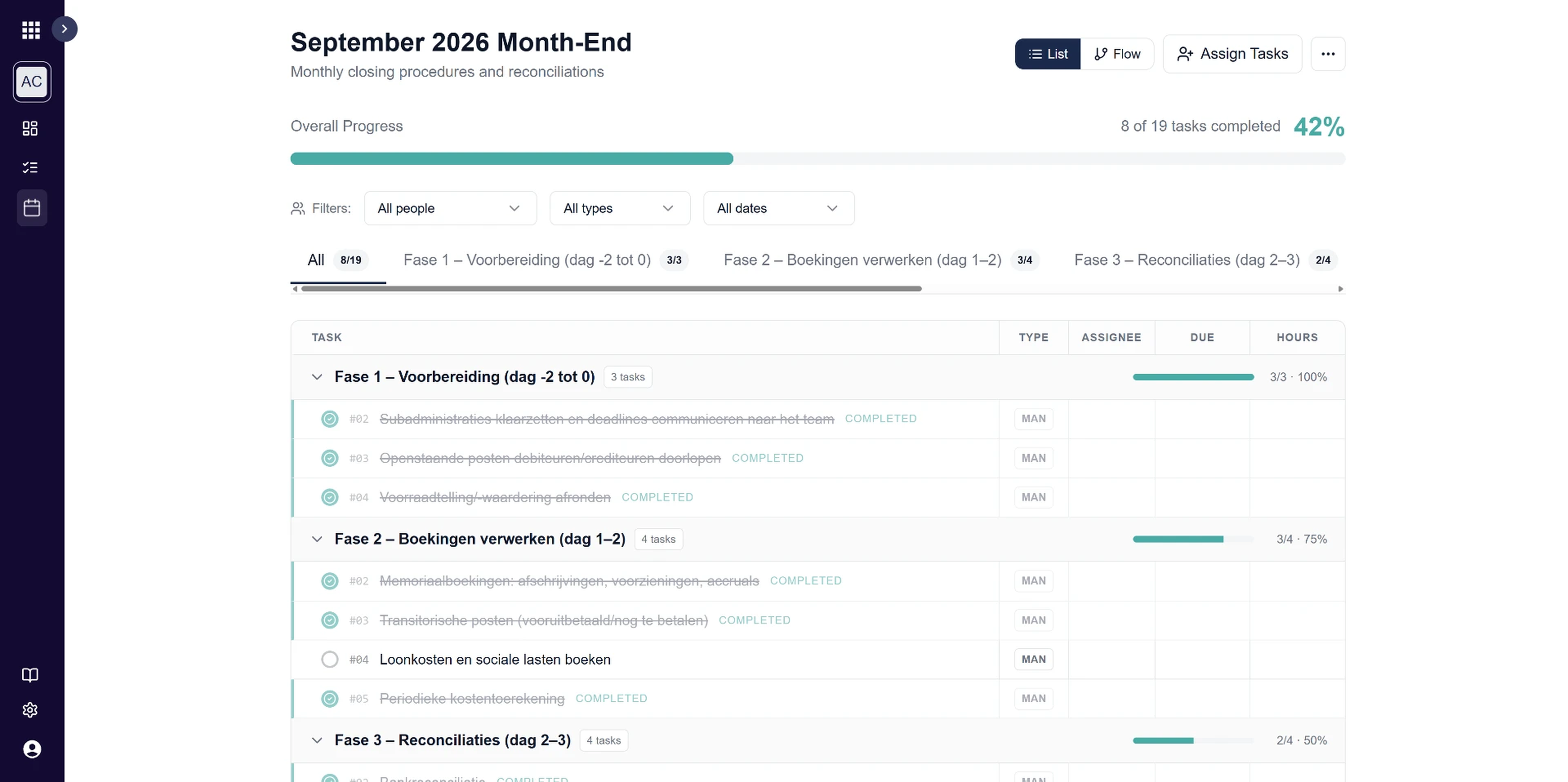
Define your month-end, quarter-end, and year-end close once as a template, with tasks, deadlines, dependencies, and automations, and reuse it every period. Automations only fire after the tasks they depend on are completed, so the order is enforced without anyone having to police it.
- Templates for month, quarter, and year, set up once, reused every period
- Tasks with deadlines and owners, no emails or verbal agreements
- Dependencies between tasks, automations wait for predecessors
- Works at both entity and consolidated level
Collaboration and documentation
Per task you add work descriptions and documents to the template, so nobody has to figure out from scratch how things were supposed to be done. Discussions happen in the chat per task, and everything that happens, who, when, why, is automatically captured in the audit trail.
- Work descriptions and documents attached to each task in the template
- Per-task chat, discuss with colleagues without email or Slack
- Audit trail: who did what, when
- Knowledge stays in the system, not with one person
Inventory adjustment WH-NL is booked, can we proceed?
Confirmed, signed off by operations. IC can start.
Smart Story, automatic variance analysis
The moment the books are ready, Smartbooks runs the analyses automatically and surfaces what stands out, instead of you having to go looking. Standard analyses run in parallel: Transaction, Budget, Trend, and Ratio. Only variances above your own thresholds reach your desk, with severity scoring so you know what to look at first. Per variance you choose: booking error, explain, or ignore, and the explanation stays on file for audit and for next month.
- Four analyses automatically: Transaction, Budget, Trend, and Ratio
- Thresholds you set, no noise from immaterial variances
- Severity scoring per variance for prioritization
- Decision per variance captured for the audit trail
Entity, consolidation, and publication
The close checklist works at both entity and consolidated level. A period can only be published once all tasks are completed. With Reporting Period Management you preview the period before it goes live, so consolidation and reporting only ever run on fully controlled data. Only admins can publish.
- Close at entity and consolidated level
- Reporting Period Management: preview before you publish
- Publishing reserved for admins, controlled process
- Reports always run on published, controlled data
"A month-end close shouldn't be a project that gets improvised every time. With a fixed process, automatic variance analysis, and controlled publication, close finally becomes what it always should have been: a reliable cycle, not a sprint."
Connects directly with Exact Online, Exact Globe, Twinfield, AFAS and Odoo.


More on close
Frequently asked about close
See Smartbooks in action
See Smartbooks live in action
In our live webinar we walk you step-by-step through consolidating, analysing and reporting with AI — with room for your questions.
- Demo in a real multi-entity environment
- How to shorten your monthly close by days
- Real-world examples from finance teams like yours

Free Whitepaper
Discover in our whitepaper how AI is transforming the financial sector and how your organization can benefit.